Carpenter Bees Control in Aveley WA
Specialised wood-boring insect management protecting timber pergolas, decks, fascia boards, and roof rafters from structural tunneling while safeguarding beneficial pollinators.
Understanding Carpenter Bees Control in Aveley WA
Carpenter bees control in Aveley is a targeted timber preservation and pest treatment protocol focused on locating, treating, and sealing structural wood galleries excavated by solitary wood-boring bees (predominantly Xylocopa species) into outdoor pergolas, exposed rafters, cedar cladding, and wooden decking.
Unlike honeybees or bumblebees that live in social hives, female carpenter bees are solitary wood borers equipped with powerful mandibles. In Aveley and the Swan Valley, they drill perfectly circular 10mm to 12mm entry holes into untreated or weathered softwoods and eucalyptus timbers. Once inside, they turn at a 90-degree angle and bore longitudinal tunnels extending 150mm to 300mm along the timber grain to deposit eggs in partitioned brood cells. Left unaddressed over multiple seasons, successive generations re-use and expand these internal galleries, severely compromising the structural integrity of outdoor living structures.
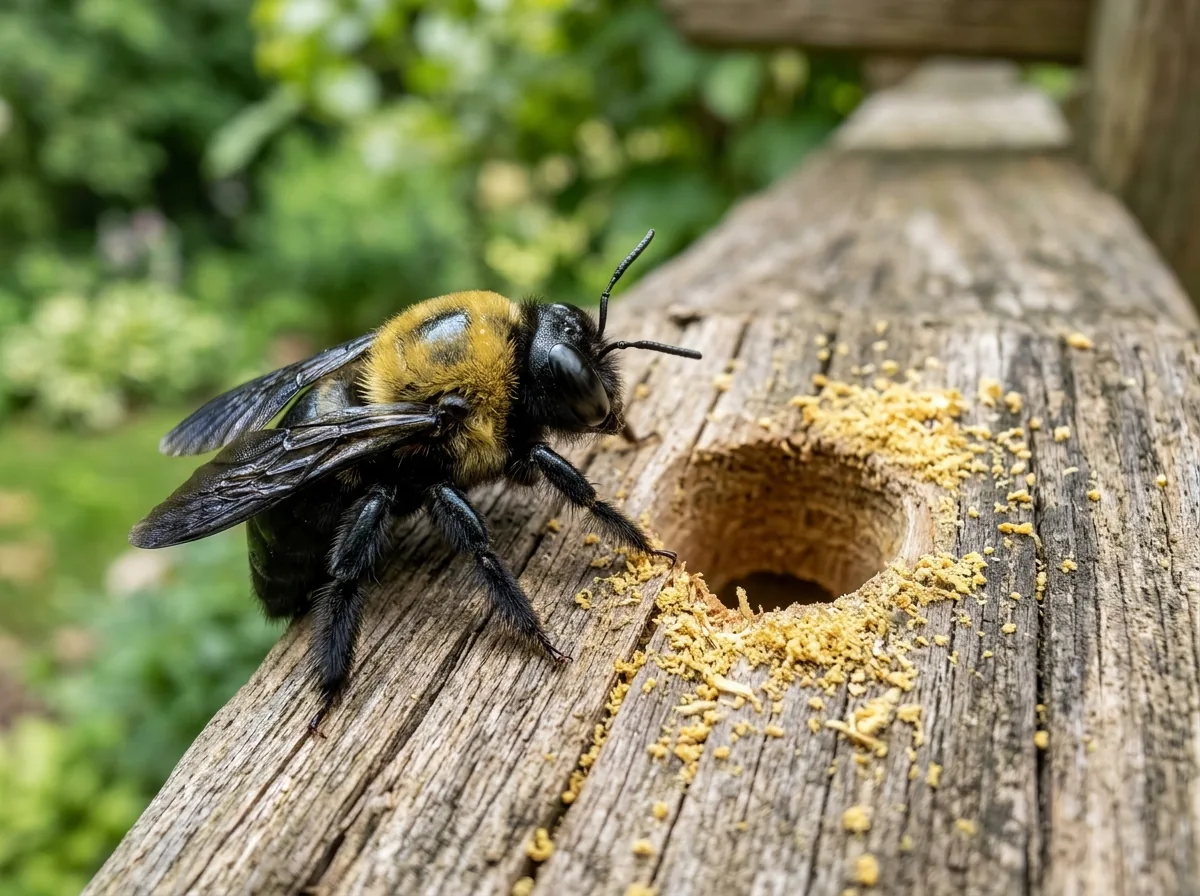
Wood-Boring Carpenter Bee (Xylocopa spp.)
Large solitary wood-boring bees that drill perfectly smooth 10–12mm circular entry holes into untreated timber pergolas, roof fascias, and decking. Multi-year gallery tunneling weakens wooden beams and attracts destructive cockatoos.
Signs of Carpenter Bee Activity in Your Timber
- Perfect Circular Holes: Clean, smooth entry holes measuring approximately 10mm to 13mm in diameter (looking like they were drilled with a high-speed wood auger bit).
- Piles of Coarse Sawdust (Frass): Accumulations of fresh, powdery wood shavings on outdoor patio floors, deck surfaces, or outdoor furniture directly beneath bored timbers.
- Yellowish-Brown Fecal Staining: Distinctive streaks of liquid waste deposited on the timber surface immediately below the gallery entry point.
- Hovering Drone Bees: Large, robust metallic-black or greenish bees hovering aggressively at eye level near timber eaves to defend territory (male bees hover closely but lack stingers).
Our Carpenter Bee Management Process
Timber Gallery Mapping
Surveying outdoor pergolas, roof fascias, and decking joists using acoustic probes to locate active bee tunnels.
Direct Gallery Dusting
Injecting micro-fine residual insecticidal dust directly into internal timber galleries using curved nozzles.
Plugging & Sealing
Sealing treated holes with timber dowels and exterior weatherproof sealant to prevent moisture and re-entry.
Timber Preservation
Applying protective preservative coatings across timber surfaces to discourage future exploratory boring.
⚠️ Structural Danger: Secondary Cockatoo & Bird Damage
In the Swan Valley and Aveley corridor, native birds such as black cockatoos and corellas quickly detect carpenter bee larvae inside timber galleries. Birds will violently rip and shred timber pergolas with their beaks to excavate the fat, protein-rich grubs, destroying decorative beams in a single afternoon.
💡 Pro Tip for Timber Longevity
Carpenter bees overwhelmingly prefer unpainted, weathered softwoods (such as untreated pine, cedar, and weathered jarrah). Applying a high-grade polyurethane enamel paint or regular coats of timber penetrating oil fills surface pores and provides an unpalatable barrier that deters drilling.
Real-World Carpenter Bee Eradication Case Study
A homeowner in The Vines noticed 14 distinct circular drill holes along an exposed jarrah patio pergola. Fresh sawdust was falling onto outdoor dining tables daily.
Our technician confirmed 9 active carpenter bee galleries. We injected permethrin micro-dust directly into each chamber, allowed 48 hours for complete mortality, then sealed each opening with hardwood dowels and matching weatherproof silicone.
Zero further tunneling. The structural strength of the pergola beams was preserved, completely halting secondary bird excavation risks.
Carpenter Bees vs. European Honeybees
| Attribute | Carpenter Bees (Xylocopa spp.) | European Honeybees (Apis mellifera) |
|---|---|---|
| Nesting Behavior | Solitary; excavates individual tunnels inside solid timber | Social colonies; builds wax comb hives in hollows or cavities |
| Timber Impact | Direct structural damage from boring holes and tunnels | Zero wood damage; does not chew or bore into timber |
| Appearance | Large, robust (18–26mm), shiny hairless black abdomen | Smaller (12–15mm), hairy golden-amber striped abdomen |
| Sting Risk | Males cannot sting; females sting only if physically crushed | Defensive worker bees sting if hive is approached |
| Conservation Protocol | Targeted gallery treatment strictly on structural wood | Relocation to certified apiarists whenever feasible |
Frequently Asked Questions About Carpenter Bees Control
Do carpenter bees eat wood like termites?
No, carpenter bees do not digest or consume cellulose. They merely excavate wood using their powerful jaws to create hollow nesting chambers for their brood. They discard the chewed wood particles outside the hole in the form of coarse sawdust (frass).
Why shouldn't I just caulk the hole closed immediately?
If you seal an active hole without first applying an insecticidal dust, the trapped adult bee or emerging juvenile will simply bore a new exit hole through adjacent timber, doubling the structural damage to your pergola or deck beam.
Can carpenter bee holes cause timber rot in Perth's climate?
Yes. The entry holes allow winter rainwater to penetrate deep into the untreated heartwood of the timber beam. Trapped moisture triggers fungal decay (dry rot and wet rot), accelerating beam sagging and eventual collapse if left unsealed.
Protect Your Timber Structures
Schedule an inspection of your timber pergola, decking, or roof fascia with our Aveley technicians.